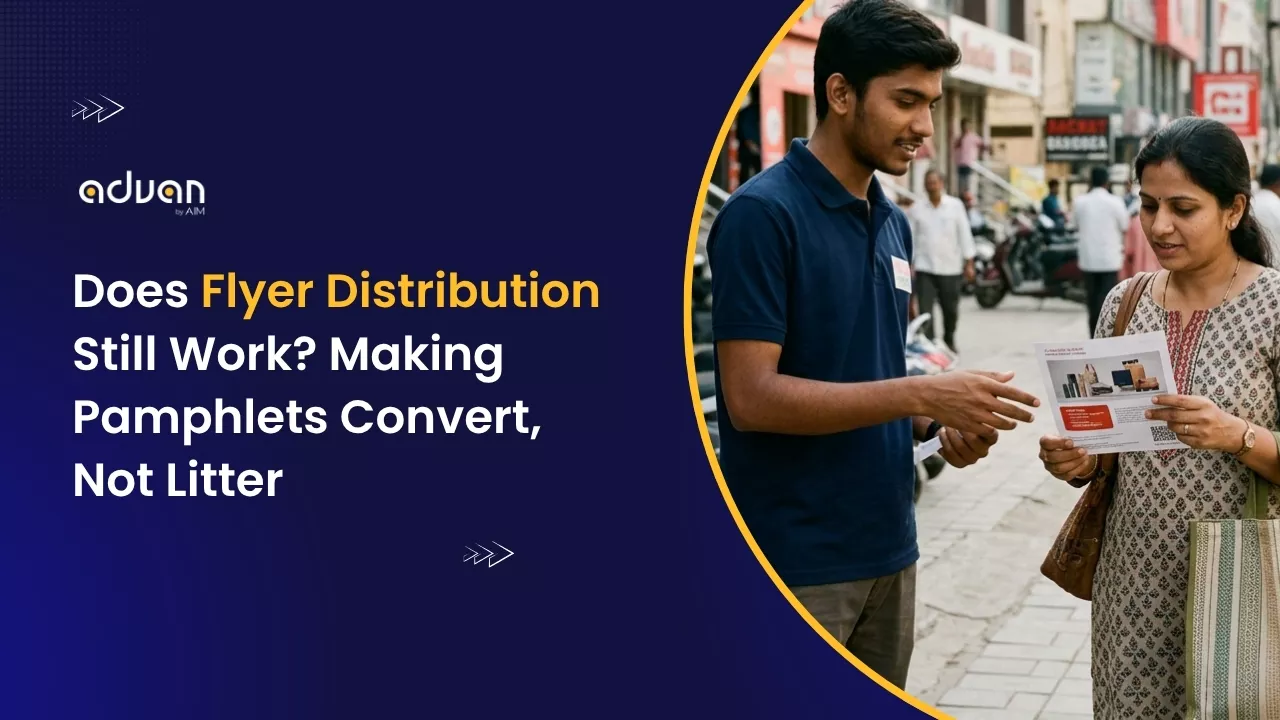
Flyer distribution has a reputation problem. For a lot of marketers it brings to mind a bored person at a traffic signal pushing pamphlets through car windows, most of which become litter before the light turns green. In an age of precise digital targeting, handing out paper on the street can feel almost quaint. So the fair question is: does flyer distribution still work, or is it a waste of trees and budget? The honest answer is that it absolutely still works, but only when it is done as targeted distribution with a reason to act, and it absolutely wastes money when it is done the way most people picture it. The format is not the problem. The thoughtlessness is.
Why bad flyer distribution fails
Start with why the format earned its bad name, because the failure is instructive. The classic flyer drop hands paper to whoever is physically present, with no regard for whether they are a potential customer. It offers no compelling reason to keep the flyer or act on it, just information nobody asked for. And it measures nothing, so the brand has no idea whether a single flyer led to anything. Hand a generic pamphlet to a random crowd with no offer and no tracking, and of course most of it ends up on the ground. That is not flyer distribution failing. That is scattergun distribution failing, which it would in any medium.
Why flyer distribution still works
Despite the cliches, physical flyers retain real advantages that keep the format alive. A flyer is tangible: it stays in a hand, a pocket, a bag, a fridge door, lingering in a way a scrolled-past ad does not. It can be hyper-local, reaching a specific neighbourhood, street or catchment with precision digital struggles to match at the street level. It is immediate and low-friction, no app, no login, just a message in the hand. And it reaches people who are light on digital or in the physical moment of need, outside a store, near a venue, in a residential pocket. For a local business, a new store, a service with a defined catchment, these are exactly the strengths that matter. There is also a cost reality in its favour: reaching a tightly defined local pocket with a physical, in-hand message is often cheaper and more certain than buying enough digital impressions to be sure you have covered the same few streets, where a large share of the spend leaks to people far outside the catchment.
Who is the flyer actually going to?
The first thing that separates distribution that converts from distribution that litters is targeting. A flyer handed to a relevant person near the point of need is worth a hundred pushed on random passers-by. That means choosing where and to whom with intent: the neighbourhood around a new store, the catchment of a service, the people leaving a relevant venue, the households in a specific residential cluster. A restaurant flyer in the hands of office workers at lunchtime nearby is targeted. The same flyer thrust at drivers on a highway is litter in waiting. Decide who the flyer is for before deciding how many to print, and the whole economics change.
Is there a reason to keep it and act on it?
The second thing is the offer. A flyer that only informs gets discarded; a flyer that gives a reason to act gets kept. A genuine discount, a limited-time deal, a free trial, something the recipient actually wants, turns a piece of paper into a thing of value worth holding onto until they use it. The strongest flyers make the action easy and immediate: a clear offer, a simple way to redeem, a nearby place to use it. Without a reason to act, even a perfectly targeted flyer is just well-aimed information. With one, it becomes a prompt that sits in a pocket until the recipient does what it asked.
Can you tell if it worked?
The third thing, and the one that turns flyer distribution from a hopeful cost into a measurable channel, is tracking. The old format measured nothing. The modern version builds in a way to know: a unique code or coupon on the flyer, a dedicated phone number, a QR code to a specific page, an offer that can only have come from the flyer. When redemptions are tracked, the brand learns how many flyers led to action, which areas and messages worked, and what each response cost, which means the next drop is sharper. A flyer campaign you can measure is one you can improve. A flyer campaign you cannot is the one that deserves the format’s bad name.
Making pamphlets convert, not litter
Put the three together and the format transforms. Target the distribution to relevant people near the point of need. Give a genuine reason to act, an offer worth keeping. And build in tracking so you know what happened and can improve. Add decent design that communicates clearly and quickly, and respect for the public and the place so the drop does not become actual litter, and flyer distribution stops being a cliche and becomes what it can be: an affordable, hyper-local, tangible way to drive action in a specific area. The difference between a pamphlet that converts and one that litters is entirely in the thinking that went in before it was printed.
When flyer distribution is the right call
The format fits some jobs better than almost anything else. A new local store or restaurant announcing itself to its immediate neighbourhood. A service business with a defined catchment it wants to own. A time-sensitive local offer, a sale, an opening, an event. A product targeting an audience that is light on digital or best reached in a physical moment. In these cases a targeted, offer-led, tracked flyer drop can out-perform a digital spend that scatters impressions across people who will never walk through the door. The question is never flyers versus digital in the abstract. It is which one reaches this local buyer, with this offer, most efficiently. For a business whose customers come from the surrounding few kilometres, the honest answer is frequently a blend, with flyers doing the close, physical, high-certainty work in the catchment and digital extending the reach beyond it.
How advan runs flyer distribution
At advan, flyer distribution services is run as targeted, measurable local marketing, not a street giveaway. That means distributing to relevant people near the point of need rather than to any passing crowd, building in a genuine offer that gives a reason to keep and act on the flyer, and adding a code, number or QR link so redemptions can be tracked and the next drop improved. Design is kept clear and the distribution respectful of the place, so the campaign drives action rather than creating litter. The format is judged on responses and cost per response, which is the only way to know a flyer drop actually worked.
The format was never the problem
Flyer distribution did not stop working; a lot of it was never done well in the first place. Hand generic paper to a random crowd with no offer and no tracking, and you get litter and a bad reputation. Target it, give a real reason to act, and measure what comes back, and the same format becomes a sharp, affordable way to move a local audience. In a world of rising digital costs and shrinking attention, a well-run flyer drop in the right neighbourhood still earns its place. The pamphlet on the ground was never the format’s fault. It was the plan’s.
Frequently asked questions
Does flyer distribution still work?
Yes, when it is targeted, offer-led and tracked. A flyer given to a relevant person near the point of need, with a genuine reason to act and a way to measure redemptions, drives real action. Generic paper handed to a random crowd with no offer and no tracking is what becomes litter.
How do you make flyers convert instead of becoming litter?
Target the distribution to relevant people in the right neighbourhood, give a genuine offer worth keeping and acting on, and build in tracking through a code, number or QR link. Add clear design and respect for the place, and the drop drives action rather than waste.
When is flyer distribution the right choice?
For a new local store or restaurant, a service with a defined catchment, a time-sensitive local offer or event, or a product best reached in a physical moment or among audiences light on digital. In these cases a targeted flyer drop can out-perform scattered digital impressions.
How do you measure a flyer campaign?
Put a unique code or coupon, a dedicated number, or a QR code to a specific page on the flyer, so redemptions can only have come from it. Tracking tells you how many flyers led to action, which areas and messages worked, and the cost per response, so the next drop is sharper.