
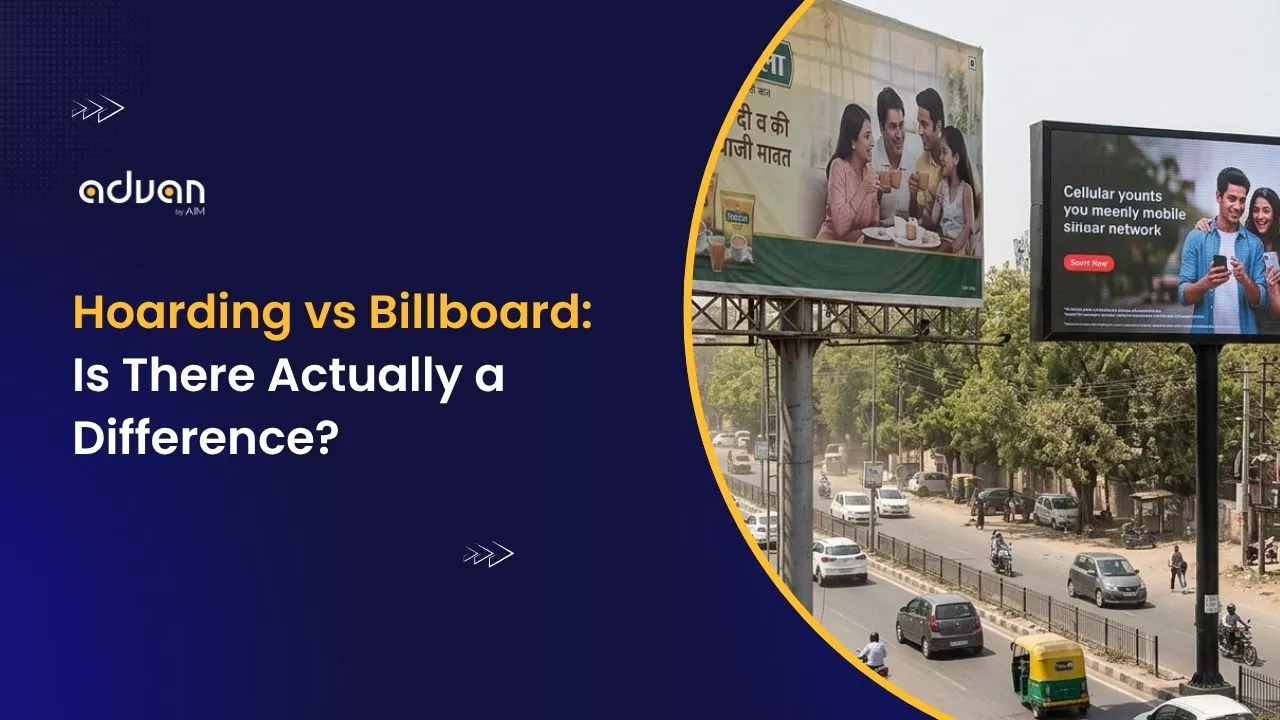
Walk into a conversation about outdoor advertising in India and you will hear the words hoarding and billboard used as if they are the same thing. One person says they want a hoarding on the highway, another calls the same structure a billboard, and a media plan will happily list both without ever explaining whether they mean something different. So the honest question is worth asking plainly: hoarding versus billboard, is there actually a difference, or are these just two names for the same big rectangle by the road? It is the kind of question nobody stops to ask, because everyone assumes they already know, and yet the answer shapes how clearly a brand can brief and buy outdoor advertising.
The short answer is that they are mostly the same thing, with a difference that is more about language and history than about the structure itself. But the longer answer is useful, because understanding where the words come from helps a brand talk about outdoor advertising clearly and avoid being confused by a vendor who uses the terms loosely.
What is a hoarding?
A hoarding is the term used across India and much of the Commonwealth for a large outdoor advertising structure, a big framed display mounted on a wall, a rooftop or a standalone support, carrying a printed or digital advertisement. When an Indian brand, a media owner or a municipal body talks about outdoor advertising, hoarding is the default word. A highway hoarding, a rooftop hoarding, a wall-mounted hoarding: all of these describe a large format out-of-home display meant to be seen from a distance by people passing on foot or in vehicles.
The word itself comes from an older English usage for a temporary fence or boarding put up around a construction site, which advertisers began using to post bills. Over time, in Indian and British English, hoarding came to mean the advertising structure itself, and that is how it is used here today. For most people in Indian advertising, hoarding is simply the native, everyday word for a large outdoor display, with no technical definition attached to it beyond that.
What is a billboard?
A billboard is the American English term for exactly the same idea: a large outdoor advertising structure carrying a printed or digital message, designed to be seen from a road. The word comes from bill, meaning a printed advertisement or poster, and board, the surface it was posted on. A board for posting bills became a billboard.
Because so much global marketing language, and so much of the internet, is written in American English, billboard is the word most people recognise worldwide, and it has become common in Indian usage too, especially among younger marketers and digital-first brands. So in India you will hear both, often from the same person in the same meeting, meaning the same structure. In practice, which word a person reaches for often says more about where they learned their marketing than about the board in front of them. Neither word is wrong, and neither is more correct. They simply come from different places and have ended up side by side in the same Indian conversations.
So is there actually a difference between a hoarding and a billboard?
In everyday practice, no. A hoarding and a billboard refer to the same thing: a large-format outdoor advertising display. The difference is one of dialect, not of structure. Hoarding is the Indian and British word, billboard is the American word, and both describe the same large roadside advertising format. If a brand asks advan for a hoarding on a particular route and a competitor asks for a billboard on the same route, they are asking for the same thing. Nothing about the structure, the price or the planning changes based on which of the two words appears in the brief.
There are a few soft distinctions that some people in the industry draw, though none of them is a firm rule. Some use billboard to imply a very large, premium, standalone structure and hoarding for a more general or wall-mounted one. Some associate billboard with the newer digital screens and hoarding with traditional printed flex. These shades of meaning exist, but they are inconsistent, and you cannot rely on them. A premium digital screen in one city is called a hoarding and in another a billboard, by people doing the exact same job. One vendor’s hoarding is another vendor’s billboard. So if a difference ever matters in a specific deal, it has to be spelled out in the contract and the specification, not assumed from the word alone, because the word carries no guaranteed meaning on its own.
Why does the confusion matter for a brand?
If the two words mean the same thing, why bother clarifying at all? Because loose language is where misunderstandings and mispriced plans begin. When a brand and a vendor use different words, each assuming the other means exactly what they mean, the brief gets fuzzy, and a fuzzy brief is how you end up with a structure that is the wrong size, the wrong format or in the wrong place for what you actually wanted. The problem is rarely that someone used the wrong word; it is that everyone assumed the word meant what it means to them, and nobody checked.
The fix is not to argue about the words. It is to describe the actual thing you want, in terms that cannot be confused. Rather than saying hoarding or billboard and assuming the vendor pictures what you picture, specify the format, the size, the location and whether it is printed or digital. Those specifics are what matter, and they cut through the dialect difference entirely. A clear specification makes the word you used irrelevant, because the vendor now knows exactly what you are buying regardless of whether you called it a hoarding or a billboard.
What should you actually specify instead of just hoarding or billboard?
When you plan an outdoor campaign, the words hoarding and billboard tell a vendor almost nothing on their own. What tells them everything is the detail underneath. A few things are worth naming every time.
Name the format precisely. A standalone roadside structure, a rooftop display, a wall-mounted panel, a gantry across a road and a digital screen are all loosely called hoardings or billboards, yet they behave very differently for a brand. Say which one you mean.
Name whether it is static or digital. A printed flex display and a digital out-of-home screen are both billboards by name, but one shows a single creative for the duration and the other can rotate several, and they are priced and planned completely differently.
Name the location and what you want from it. A highway structure seen at speed, a city-centre display seen in slow traffic and a neighbourhood panel seen by local residents do different jobs. The word hoarding or billboard says nothing about which job you are buying.
Name the size and the viewing distance. A structure meant to be read from across a wide junction needs a very different design and scale from one seen up close in a market lane. Specifying this protects you from a display that is technically a billboard but useless for your purpose. A board that is the wrong scale for its viewing distance is a common and expensive mistake, and it has nothing to do with whether anyone called it a hoarding or a billboard.
How advan thinks about hoardings and billboards
At advan, the word a brand uses is never the point. Whether a client asks for a hoarding or a billboard, the first job is to translate that into what they actually need: the right format, the right size, the right location and the right static-or-digital choice for the message and the audience. Outdoor advertising works when the structure is matched to the job, seen clearly by the right people, and planned with the permissions and the timeline it really requires. It fails when a vague brief, built on loosely used words, produces a display that is large and visible and wrong. So advan treats hoarding and billboard as the same starting point, two names for a large outdoor format, and moves the conversation quickly to the specifics that decide whether the money works. The structure is only the vehicle; the real decisions are location, format, size, timing and whether the creative actually reads at the distance and speed people will see it.
Hoarding or billboard, then, is a question about language more than about structure. They are two words for the same large roadside advertising format, one Indian and British, one American, both pointing at the same thing. The difference that actually matters to a brand is not which word you use, but how precisely you describe the format, the location and the job you need it to do. Get those right and it does not matter at all what you call the board.
Frequently Asked Questions
Is a hoarding the same as a billboard?
Yes, in everyday practice they are the same thing: a large outdoor advertising structure seen from a road. Hoarding is the Indian and British term; billboard is the American term. The difference is dialect, not structure.
Why are two different words used for the same thing?
Hoarding comes from an older English word for a boarding around a site where bills were posted, and became the Indian and British term. Billboard comes from a board for posting bills and is the American term. Both spread into Indian usage, so you hear both.
Is there any real distinction between the two?
Some people loosely use billboard for very large, premium or digital structures and hoarding for general or wall-mounted ones, but this is inconsistent and not a rule. You cannot rely on the word alone to tell you the format.
What should I specify when booking outdoor advertising?
Describe the actual thing, not just hoarding or billboard: the exact format, static or digital, the location and the job you want it to do, the size and the viewing distance. Those specifics cut through the dialect difference entirely.