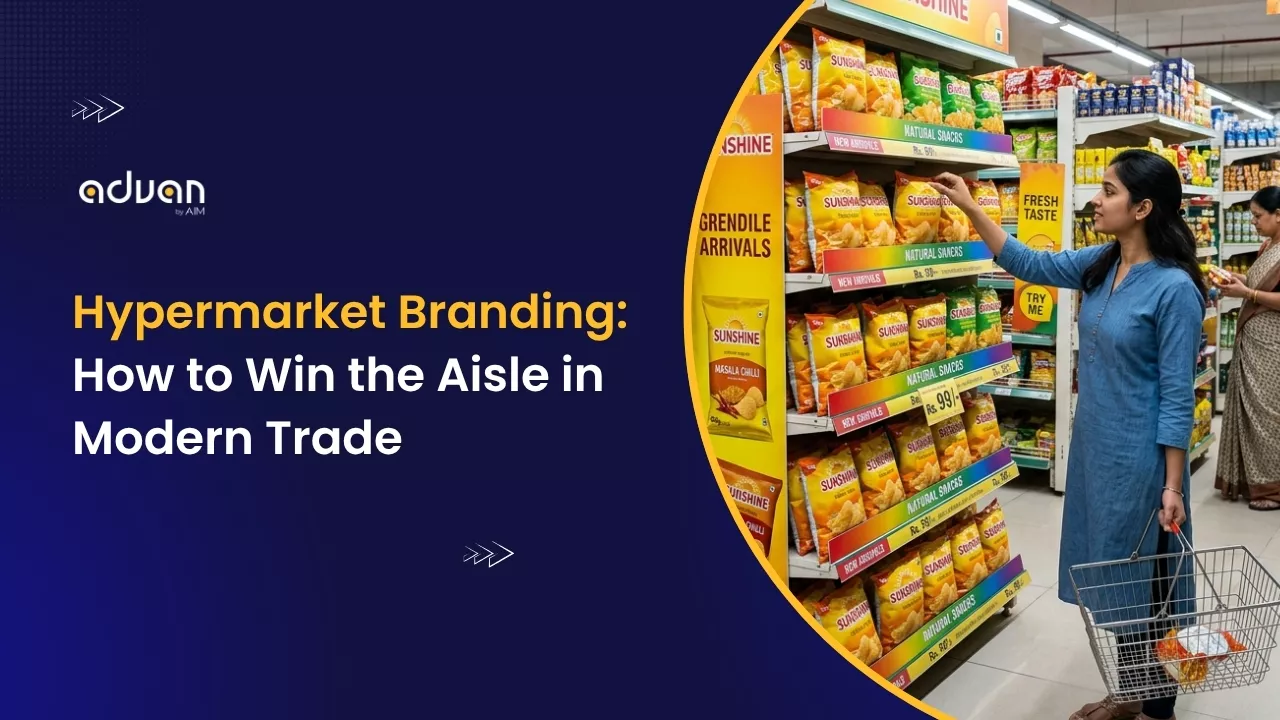
A hypermarket is where a lot of purchase decisions are actually made, and lost. A shopper walks in with a loose list and an open mind, moves down aisles stacked with competing brands, and in a few seconds per category decides what goes in the trolley. No salesperson intervenes. No ad is playing. It is just the shopper, the shelf, and whatever each brand has done to earn the glance. Hypermarket branding is the craft of winning that moment: making your brand the one the eye lands on and the hand reaches for, in an environment built to overwhelm. Here is how it is done.
Why the hypermarket aisle is its own battlefield
Modern trade is different from a small store. There is no shopkeeper to recommend you, no counter conversation, just rows of products competing for a distracted shopper moving at pace. Choice is enormous and attention is thin, so the decision is made fast and visually. The brand that wins is rarely the one with the best product on paper; it is the one that is easiest to notice, understand and trust in the two seconds the shopper spends in front of the category. Hypermarket branding exists because the shelf is a battlefield, and most of the fighting is for the eye before it is ever for the wallet.
Winning the eye: visibility on a crowded shelf
The first job is to be seen. On a shelf of twenty similar products, the one that stands out gets considered, and the rest get skipped. That standing out comes from strong, consistent brand blocking, packaging and branding that create a recognisable wall of your colour and identity on the shelf, from clear visibility of the brand at a distance down the aisle, and from any secondary branding the store allows, shelf strips, danglers, end-cap displays, that pull the eye to your section. A shopper cannot choose a product they never noticed. Visibility is not vanity in a hypermarket; it is the entry ticket to being considered at all.
Winning the understanding: clarity in two seconds
Being noticed is only half the job; the shopper then has to grasp what the product is and why it is for them, fast. In the few seconds of attention, the packaging and branding have to communicate the category, the key benefit, and the reason to pick this one, with no time for the shopper to study or decipher. Cluttered packaging that tries to say everything says nothing in two seconds. The brands that win are clear: an obvious what-it-is, a single strong reason-to-buy, and a design the eye can read instantly. In modern trade, clarity beats cleverness, because the shopper has no time to be clever back.
Winning the trust: looking like the safe choice
At the shelf, a shopper is making a small risk decision, and branding signals whether your product feels like a safe, credible choice. Quality of design, consistency, and a professional presence all tell the shopper, without a word, that this is a brand to trust. A cheap-looking pack or inconsistent branding plants doubt at the exact moment of decision. This matters most for newer or challenger brands sitting beside established names: strong, confident branding is how they earn the benefit of the doubt and get picked despite being less familiar. On the shelf, looking trustworthy and being trustworthy have to arrive together, because the shopper only sees the first one.
Winning the location: where you sit in the store
Not all shelf space is equal, and hypermarket branding includes fighting for position. Eye-level shelves get far more attention than the top or bottom. End-caps and promotional zones command the aisles. The high-traffic paths through the store see more shoppers than the quiet corners. Securing better placement, through the store relationship, through promotions, through branded displays, puts the brand where more eyes and hands actually are. A great pack in a poor position still loses, because the shopper never reaches it. Winning the aisle is partly about the brand and partly about the real estate it occupies. This is why the store relationship matters as much as the design studio: the best packaging in the world, parked on a bottom shelf in a low-traffic corner, quietly loses to an ordinary rival sitting at eye level on the main path.
Winning the moment: trial and promotion at the shelf
Sometimes the branding alone is not enough to break a shopper’s habit, and the store offers tools to push them over the line: in-store sampling, demonstrations, shelf promotions, and offers that give a reason to try now rather than later. For a new product especially, letting a shopper taste, feel or try it right at the point of decision can convert a glance into a purchase on the spot. These activations work best when they are integrated with the branding, reinforcing the same message, so the shopper who was drawn by the shelf is closed by the trial. Branding earns the attention; the activation can earn the sale.
How to measure whether your aisle branding is working
Hypermarket branding should be judged on what it moves, not how it looks. The signals are there if you look: off-take from the sampled or branded stores versus comparable ones, the lift during a branding or promotion period, the share of category the brand holds on those shelves. Comparing stores where you invested in branding and placement against stores where you did not shows the real effect. A brand that treats shelf branding as a cost with no measurement cannot improve it. A brand that reads the off-take learns which stores, placements and tactics actually won the aisle, and puts the next rupee there.
Consistency across stores is the quiet multiplier
One well-branded shelf in one store is a nice win. The same confident presence across every hypermarket a shopper visits is a brand. Modern-trade shoppers move between outlets, and seeing the identity look sharp and identical everywhere builds a familiarity that a single strong store can never create. The opposite is just as true: a brand that looks premium in one hypermarket and ragged in the next trains shoppers to doubt it. Consistency across the whole chain of stores, the same blocking, the same quality, the same clarity, turns scattered shelf presence into recognition that follows the shopper from one trip to the next. It is unglamorous work, and it is where a lot of category leaders quietly separate themselves from challengers who branded one flagship store and neglected the rest.
How advan approaches hypermarket branding
advan’s hypermarket branding is built around the two-second decision at the shelf. That means strong, consistent brand blocking and visibility so the product is noticed down a crowded aisle, packaging and branding clear enough to be understood and trusted in a glance, a fight for the placement that puts the brand where the eyes and hands are, and shelf-level activation that converts attention into trial where it helps. And it is measured on off-take and category share rather than appearance, so the brand can see which stores and tactics actually won the aisle. The goal is to be the easy, confident choice in the moment the shopper decides.
The aisle is won before the shopper knows it
By the time a shopper reaches for a product, the real contest is already over. It was decided by which brand got noticed, understood, and trusted in the two seconds the category got, and by which one was standing where the eye naturally fell. Hypermarket branding is how a brand wins that contest on purpose instead of by luck. Be the easiest to see, the fastest to understand, the most reassuring to trust, and the best-placed to reach, and you become the default choice in modern trade. Lose any one of those, and you become the product the shopper walked right past without ever knowing you were there.
Frequently asked questions
What is hypermarket branding?
It is the branding and presence that make a product the one a shopper notices, understands and trusts at the shelf in modern trade, where there is no salesperson and the decision is made in seconds. It covers packaging, shelf visibility, placement and in-store activation.
How do you stand out on a crowded hypermarket shelf?
Through strong, consistent brand blocking that creates a recognisable wall of your identity, clear visibility down the aisle, secondary branding like shelf strips and end-caps where allowed, and packaging that communicates what the product is and why to buy it in about two seconds.
Does shelf placement matter in a hypermarket?
Yes, a great deal. Eye-level shelves, end-caps, promotional zones and high-traffic paths get far more attention than top or bottom shelves and quiet corners. A strong pack in a poor position still loses, so winning placement is part of winning the aisle.
How do you measure hypermarket branding?
By off-take rather than appearance: compare sales from branded or activated stores against similar stores without the investment, track the lift during branding or promotion periods, and watch category share on those shelves to see which tactics actually won.