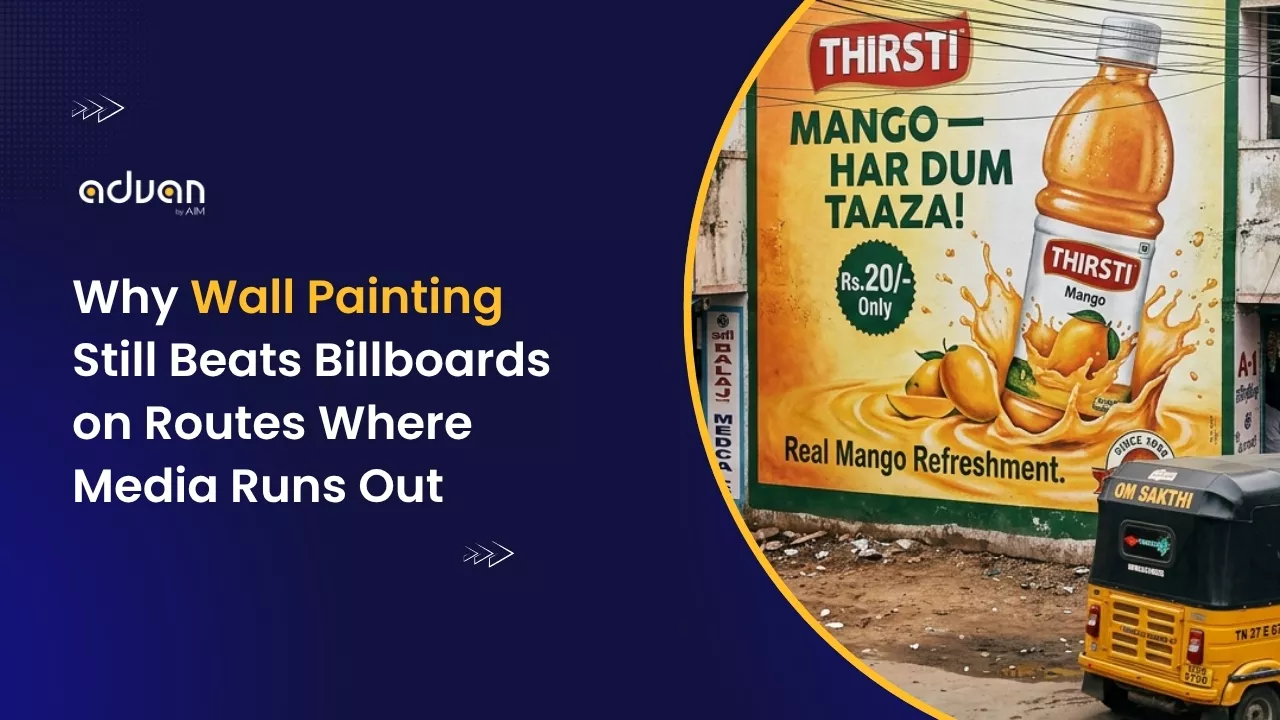
Drive two hours out of any metro and watch what happens to the advertising. The billboards thin out. The digital screens disappear. Somewhere past the ring road, the organised outdoor media simply ends, and a brand that depends on hoardings goes dark for the rest of the journey. Yet the people on that road, commuters, truck drivers, dealers, contractors, villagers heading to the nearest town, are still buying. They are just no longer being spoken to. On these routes, the brand that keeps showing up is almost never the one that booked a billboard. It is the one that painted a wall.
Wall painting is often treated as the poor cousin of outdoor advertising, something you do when you cannot afford a hoarding. That reading has it backwards. On highways and in the markets where formal media runs out, wall painting is not the cheaper fallback. It is frequently the better medium, and here is why.
Where does outdoor media actually run out?
Organised OOH advertising follows money and density. Hoardings and screens cluster where land is expensive, traffic is measured, and permissions are formalised, which means the metros, the expressways near them, and the big commercial corridors. Move beyond that and the inventory collapses. State highways, district roads, small-town markets, the approaches to industrial clusters and dealer towns: these carry real traffic and real buyers, but they have few legal hoarding sites and almost no digital screens.
For a brand whose customers live and travel there, this is a visibility hole. Building materials, agri inputs, two-wheelers, paints, tyres, lubricants, financial services for small towns: their buyers are exactly the people on these under-served roads. A billboard-only plan reaches them in the city and abandons them the moment they leave it.
Why does wall painting go where billboards cannot?
A wall is already there. Every village, every market junction, every stretch of highway with a cluster of shops has usable wall space, and the owner is usually willing to let a brand paint it for a small arrangement. That changes the whole economics of coverage. Instead of being limited to the handful of legal hoarding sites on a route, a brand can place its message at dozens of points along the same stretch, because the medium is the built environment itself.
This is the first advantage: reach where no formal inventory exists. On a route with three hoarding sites and three hundred paintable walls, wall painting is not competing with billboards. It is operating in a space billboards cannot enter at all.
How wall painting builds frequency a billboard cannot
Outdoor advertising works on repetition. One exposure rarely moves anyone; it is seeing a brand again and again along a journey that builds recognition and, eventually, trust. A single billboard gives one strong exposure and then nothing for the next forty kilometres. A series of painted walls gives a traveller the same brand five, ten, fifteen times across the route.
By the time a driver reaches the town, the name is familiar, and familiarity on a purchase decision is worth more than one dramatic sighting. For categories bought on trust from a local dealer, a tractor part, a bag of cement, a loan, that repeated roadside presence quietly does the job an expensive single hoarding cannot.
Does a painted wall last longer than a billboard booking?
A hoarding is rented by the month. Stop paying and your message comes down, replaced by the next advertiser. A well-executed wall painting stays up for a long time, often many months, with no recurring rental for the display itself. The brand keeps working on that wall long after the campaign budget has moved on.
On a route where you want sustained presence rather than a short burst, this matters. Wall painting turns a one-time cost into durable visibility, which is a very different value equation from renting a screen week by week. For a growing brand trying to own a region over time, durability is not a minor perk. It is the point.
Who actually sees roadside wall painting?
The audience on these routes is specific and valuable, and it is not the same audience a city hoarding reaches. It is commercial vehicle drivers who cover the same roads daily. It is dealers and contractors travelling between towns. It is residents of smaller towns who are brand-aware but under-served by advertising. And it is the local shopkeeper whose wall carries the message, who becomes a quiet endorser of the brand simply by hosting it.
That last point is underrated. A painted wall sits inside a community rather than above a motorway. It is seen by people who live there every day, in a context they trust, which gives it a credibility a towering hoarding on an anonymous flyover does not have. In small-town India, where a dealer’s word still closes the sale, a brand that is visible on the familiar walls of the town arrives at that dealer already half-known. The painting did the warming up before the conversation even started.
When is a billboard still the right call?
None of this means billboards are finished. On a high-speed expressway, a large hoarding does work wall painting cannot, commanding attention at distance and speed. In a premium urban market, a billboard carries a prestige a roadside wall does not. For a short, high-impact launch burst in a metro, digital OOH can do things paint never will.
The honest position is that these are different tools for different jobs. Billboards win where land is dense, audiences are urban, and the budget is for impact. Wall painting wins where media runs out, audiences are regional, and the goal is sustained, repeated presence among the people a brand actually sells to. The mistake is assuming the billboard is always the senior medium. On the routes that matter to a lot of Indian brands, it is simply absent.
What makes a roadside wall painting actually work?
A wall painting only earns its place if a moving traveller can take it in within a second or two, so execution is not decoration, it is the whole job. The name has to be large and high-contrast, readable from a distance and at speed. The message has to be short, a brand, a category, a reason to remember, not a paragraph nobody will finish. Colour has to hold up against a dusty, sun-beaten roadside rather than disappear into it. And the wall itself has to be chosen for a clear sightline, not only availability, because a perfectly painted wall behind a parked truck or a tree reaches no one.
Get these right and a simple painted wall out-performs a far more expensive display that was designed for a brochure rather than for a driver glancing sideways at sixty kilometres an hour. Most wall painting that disappoints was not beaten by billboards; it was let down by weak execution on a good wall.
How advan plans a highway wall painting campaign
At advan, a wall painting campaign on these routes starts with the route, not the wall. We map where the brand’s buyers travel and where organised media gives out, then identify wall spaces along those stretches by visibility, traffic movement and the market activity around each point. The aim is repeated, legible exposure across the whole route, so a traveller meets the brand many times between one town and the next.
Execution is built for the conditions: clear branding, strong colour, and messaging simple enough to read at speed. Because the walls stay up, the brand holds that presence for a long stretch without renting it week by week. And because wall painting reaches where nothing else does, it lets a brand close the visibility gap that a billboard-only plan quietly leaves open.
The medium that shows up where your buyers are
A brand is not built only in the cities where the hoardings are. It is built on the roads its customers actually drive, in the towns where its dealers actually sell. On those routes, the question is not whether wall painting is as good as a billboard. It is whether you are willing to go dark the moment the billboards end, or keep showing up where your buyers live. Wall painting is how you stay visible on the roads advertising forgot, and for a lot of Indian brands, that is exactly where the next customer is.
Frequently asked questions
Is wall painting cheaper than billboard advertising?
It depends on the route and scale, but the real advantage is not a lower sticker price. Wall painting reaches places that have no legal hoarding sites, places many walls along a route rather than one display, and stays up for months without recurring display rental, so the value is durable coverage where billboards cannot go.
Where does wall painting advertising work best?
On state and district highways, small-town market junctions, and the approaches to dealer towns and industrial clusters, routes that carry real buyers but have little organised outdoor media. It suits brands whose customers travel these roads, such as building materials, agri inputs, two-wheelers, paints and lubricants.
How long does a wall painting last?
A well-executed wall painting typically holds for many months, giving the brand sustained presence on the route without paying display rent week by week. Exact life depends on the wall, the paint, government regulations and the weather.
Does wall painting build brand recall?
Yes, because outdoor advertising works on repetition. A series of painted walls exposes a traveller to the brand many times across a single route, and that repeated roadside presence builds familiarity, which matters most for categories bought on trust from a local dealer.